
Apple and the difference between attachment and love
Buying a new iPhone isn’t really a decision anymore for most of us. It’s become routine. The model changes, the brand never does. And when we need the next smartwatch, the next pair of headphones, or the next laptop, the first instinct is to look toward Apple. Often so much so that the question of an alternative never even comes up.
Most brands would be happy with loyal customers. Apple has built something stronger: evangelists. People who don’t just buy themselves, but are so convinced that they convince others too.
Behind all of this sits one question: how did Apple pull this off?
Der Retention Quadrant
To answer that, we need to look at two dimensions that usually get lumped together, but actually measure two completely different things.
- Friction to leave → How hard is it to leave?
- Attachment to the brand → How attached is the customer to the brand?
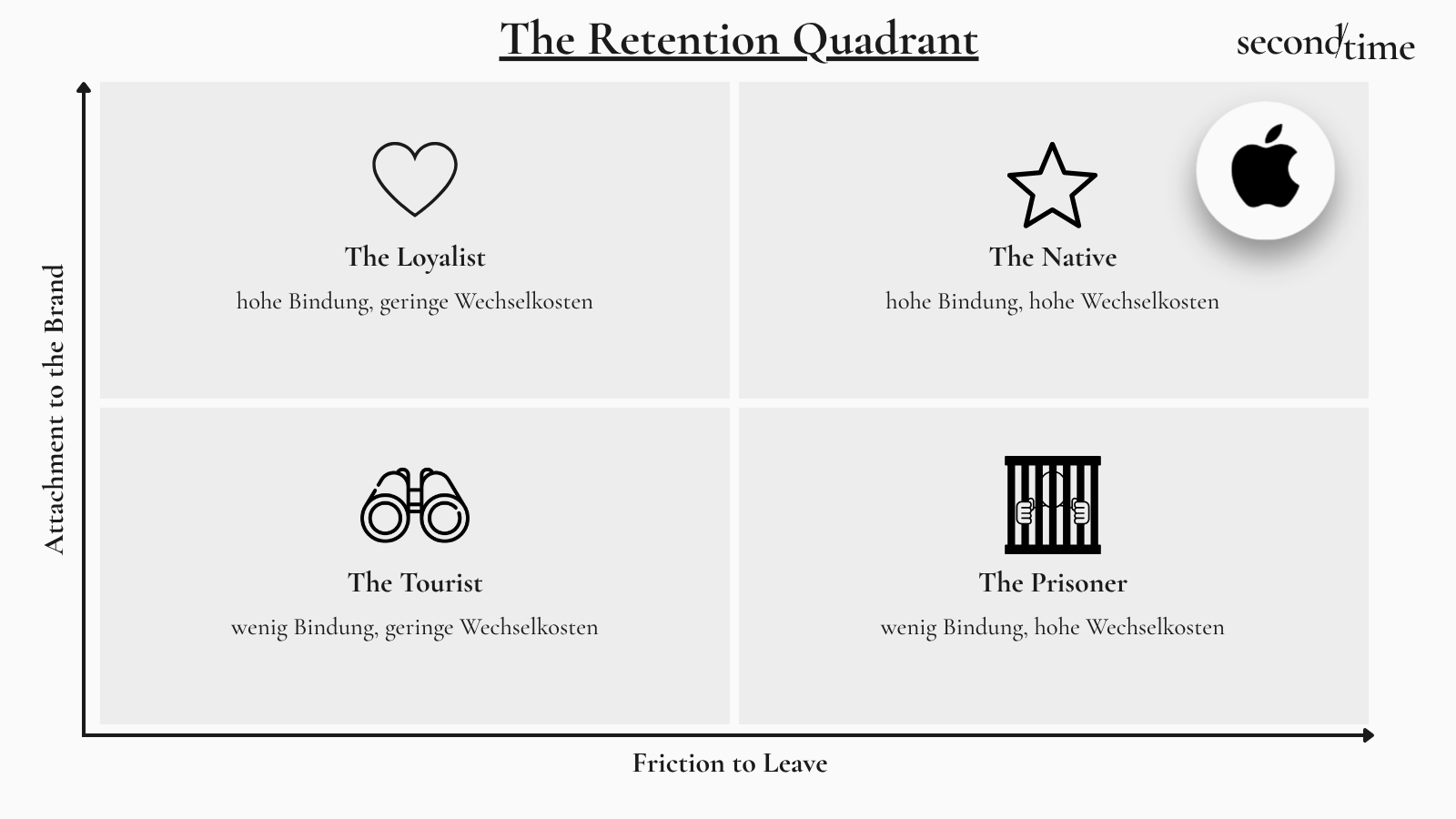
Cross these two, and you get four types of customers:
The Tourist — low attachment, low friction to leave.
They are here as long as it's convenient, and gone the moment something better comes along. Any brand that only retains through discounts is collecting tourists.
The Prisoner — low attachment, high friction to leave.
They stay because switching is too much hassle, not because they want to. They don't love you. They tolerate you. And the moment the barrier disappears, they're gone.
The Loyalist — high attachment, low switching cost.
They stay out of genuine affection, even though they could leave at any time. The most honest form of loyalty, and the most fragile one, if you take it for granted.
The Native (Apple Customers) — high attachment, low switching cost.
They want to stay, and even if they wanted to leave, it would be complicated. Both forces pull in the same direction.
Apple sits exactly where everyone wants to be. And that’s exactly what makes their case so interesting.
Why leaving Apple hurts
Let’s start with friction. The side that’s often mistaken for loyalty.
The internal ecosystem. Apple products are good on their own, but they show their real strength together. The watch unlocks the Mac, the iPhone hands a call off to the iPad, a photo shows up on every device seconds later. Every new device pulls you deeper into the system.
This starts right at onboarding. And it's almost unsettlingly good. A new iPhone has everything from the old one within minutes: photos, apps, settings, messages. This frictionlessness feels like a gift. Then there's the App Store. Every app you've bought, every subscription is tied to the platform. Switching means leaving all of it behind.
The external ecosystem. But the strongest barrier isn't in your devices at all, it's in your relationships. iMessage, "Find My", the iCloud family account, AirDrop... all of it only works as long as everyone stays in. Whoever leaves becomes the green bubble in the group chat. This switching barrier is social, not technical. And social barriers are the strongest there are.
Then there's status. Being an Apple user is an identity signal. People recognize each other, people belong. That's attachment that doesn't live in the product, but between people.
If you only looked at this side, you'd reach a cynical conclusion: Apple holds its customers hostage. But that would only be half the story, and the real trick lies in the other half.
Why so many people love Apple from the bottom of their heart
Because Apple customers aren't in the "Prisoner" quadrant. The attachment is real.
The brand story. Apple never sold itself as a technology company, but as an attitude. The brand for those who think different: for rebels, visionaries, creatives. "Think different" wasn't a product promise, it was an invitation to belong to a certain kind of person. Whoever buys an Apple device buys a piece of that story too.
Emotion over specs. Apple rarely talked about megahertz and spec sheets. The ads show people, moments, feelings. Not the technology. The product is the means, the user's life is the goal. This consistent user-centricity has stayed the same for decades.
The product itself. Everyone knows Apple isn't the price-performance king. On top of that, it's often criticized for its closed system and lack of flexibility. But here lies an underrated point:
Many people don't want complete freedom. They want to be guided. They want things to work, look good, and make life easier, without having to deal with it themselves. Apple guides its users through simple, beautifully designed experiences and takes the burden of decision-making off their shoulders. What critics see as paternalism, others experience as relief.
This is the attachment that has nothing to do with the switching barrier. Even if tomorrow every app ran on every device and iMessage was everywhere: many would stay anyway. Out of genuine conviction for the brand.
What we can take from Apple
Back to the Retention Quadrant. Apple’s strength is that it scores high on both dimensions. That’s exactly what makes the case so hard to read. Because in the numbers, lock-in and real loyalty look identical. Both are a customer who stays.
The difference only shows when the switching barrier disappears. If it falls, the loyalists stay, and the prisoners leave. By then, it’s too late to build real attachment. Apple is so strong because it has both.
The more dangerous position isn’t having a few prisoners. It’s confusing lock-in with loyalty. Believing you’re loved, when in reality you’re just hard to leave.
This leads to the real question for every brand. When we think about retention, we too often focus on just one axis: how do we make leaving harder? Contracts, ecosystems, switching costs. That keeps people, but as prisoners. The harder, more durable question is the other axis: how do we move people to want to stay?
Thanks for being here. excited to share more brand breakdowns with you soon.
Dominik Francisco
Liked the article? share it with your network.